Showing posts with label Enterprise Resource Planning. Show all posts

Thursday, June 19, 2008

Leading E-commerce and ERP Solution Provider Chosen for Comprehensive Analysis of Microsoft’s Newest ERP Platform

Ignify, a Microsoft Gold Certified Partner and provider of enterprise resource planning (ERP) and e-commerce solutions for the mid-market and large enterprise business segment, today announced the completion of the first independent analysis of Microsoft’s Dynamics AX 2009 ERP platform. Designed as an unbiased assessment covering new features, applications, look and feel of Dynamics AX, this study assists the enterprise in evaluating the new ERP release for possible implementation or as an upgrade. In addition, Ignify will be conducting several seminars and workshops for its customers, based on the findings.

The analysis, conducted by a five person dedicated Dynamics AX team at Ignify over a 60 day timeframe, consisted of a thorough breakdown of functionality and features offered by Dynamics AX 2009. Ignify goes a step further by rating each feature on scale of one to ten (ten as the best) on the importance and completeness of the feature with supporting notes on user benefits and what can be improved.

“As a Gold Certified Partner we work extremely close with Microsoft to remain on the cutting edge of innovation especially in the ERP and business solution space,” stated Sandeep Walia, CEO of Ignify. “Our unbiased account of Dynamics AX 2009 is a testament to our commitment of providing customers with the best possible solutions available on the market today.”

Formerly known as Microsoft Axapta, Microsoft Dynamics AX 2009 is a comprehensive business management and ERP solution for mid-sized and larger organizations that seamlessly integrates with familiar Microsoft software such as Outlook, Windows, Vista, Office 2007 and SharePoint, to help enhance overall productivity. The latest release offers a new interface and several added features including Breadcrumb bar (BCB) allowing the user to jump around or navigate to other areas in the system; Filter Pane for finding and viewing individual or group of related records, and Role Centers which display specific data, reports, alerts, and common tasks associated with a user's role in the organization among many others.

Ignify’s widely popular Data Archival for Microsoft Dynamics AX solution which lays the foundation for solid ERP data management by allowing enterprises to archive and view the entire database over selected time periods, is one of the first third party platforms to fully support Dynamics AX 2009. In addition, the company’s flagship e-commerce storefront has been deployed in over 200 medium to large businesses ranging from retail, automotive, apparel, distribution and manufacturing businesses among many others.

About Ignify

Ignify, established in 1999, is a privately-held ISO-9001:2000 compliant company focused on the mid-market eCommerce and mid-market accounting segment. Targeting the mid-level market, Ignify offers a comprehensive set of Business to Business (B2B) and Business to Consumer (B2C) eCommerce solutions for increasing online sales while lowering overall operation costs. The company also provides consulting services for ERP and software development initiatives and is a Microsoft Gold Certified partner and Sage Certified Partner. Ignify has offices in Los Angeles, Silicon Valley, Nashville, Seattle, Toronto and India. For more information, visit www.ignify.com or call 888-446-4395.

Source : Business Wire

Thursday, March 20, 2008

Reach Technology ERP Software for apparel manufacturing

Reach Technology ERP is the completely integrated Enterprise Resource Planning solution for effectively streamlining and integrating customer service, design, sampling, merchandising, production, distribution and financial processes and optimally utilizing resources across the enterprise.

Companies, today, must deliver products faster, better and cheaper to be successful. R-ERP is tailored to ensure your competitiveness in the apparel manufacturing and merchandising marketplace and will enable you to be more efficient, responsive and profitable.

Trends are created overnight... Fashions change quickly and without warning... as a result no industry has to adjust as fast as the apparel industry.

R-ERP allows you to automate a large number of routine events and importantly prompt human intervention when exceptional events demand it.

R-ERP will, thus, enable you to 'manage your company by exception' directing the vast majority of the company's human attention to the ‘out-of-the ordinary’ business situations that present the most risk and greatest opportunity.

What are the benefits of using REACH ERP?

- Lets you have a global view of the business cutting across various functions and enables you to react fast to market changes.

- Optimal utilization of your resources.

- Improved customer relationship management.

- Substantially increase your ROI(Return on Investment) as end-to-end integration of all company data ensures that all parties have the latest, most accurate information, cutting waste and 'queues' and shortening time-to-market cycles for new collections and styles.

- Helps you cut inventory volumes and eliminate production backlogs thereby dramatically lowering costs.

- If your competitors have access to real-time integrated information and you do not, then you're taking a real big risk.
If you have any inquiry please contact direct Reach Technology

Reach Technology Contact Detail :
49, First Main, Third Phase, JP Nagar,
Bangalore- 560 078.
India.
Tel : 91-80- 65996111, 65996112, 65996113
Fax : 91-80- 26585744
Email : sales@reach-tech.com
URL : http://www.reach-tech.com

Tuesday, March 4, 2008

ERP (Enterprise Resource Planning) Software Solution

Enterprise Resource Planning (ERP) systems attempt to integrate all data and processes of an organization into a unified system. A typical ERP system will use multiple components of computer software and hardware to achieve the integration. A key ingredient of most ERP systems is the use of a unified database to store data for the various system modules.

The initials ERP originated as an extension of MRP (material requirements planning then manufacturing resource planning). ERP systems now attempt to cover all basic functions of an enterprise, regardless of the organization's business or charter. Non-manufacturing businesses, non-profit organizations and governments now all utilize ERP systems.

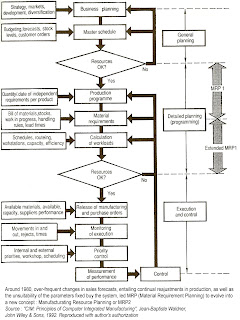
MRP vs. ERP — Manufacturing management systems have evolved in stages over the past 30 years from a simple means of calculating materials requirements to the automation of an entire enterprise. Around 1980, over-frequent changes in sales forecasts, entailing continual readjustments in production, as well as the unsuitability of the parameters fixed by the system, led MRP (Material Requirement Planning) to evolve into a new concept : Manufacturing Resource Planning (or MRP2) and finally the generic concept Enterprise Resource Planning (ERP).


To be considered an ERP system, a software package must provide the function of at least two systems. For example, a software package that provides both payroll and accounting functions could technically be considered an ERP software package.

However, the term is typically reserved for larger, more broadly based applications. The introduction of an ERP system to replace two or more independent applications eliminates the need for external interfaces previously required between systems, and provides additional benefits that range from standardization and lower maintenance (one system instead of two or more) to easier and/or greater reporting capabilities (as all data is typically kept in one database).

Examples of modules in an ERP which formerly would have been stand-alone applications include: Manufacturing, Supply Chain, Financials, Customer Relationship Management (CRM), Human Resources, Warehouse Management and Decision Support System.

Some organizations — typically those with sufficient in-house IT skills to integrate multiple software products — choose to implement only portions of an ERP system and develop an external interface to other ERP or stand-alone systems for their other application needs. For example, one may choose to use human resource management system from one vendor, and the financial systems from another, and perform the integration between the systems themselves.

This is very common in the retail sector[citation needed], where even a mid-sized retailer will have a discrete Point-of-Sale (POS) product and financials application, then a series of specialized applications to handle business requirements such as warehouse management, staff rostering, merchandising and logistics.

Ideally, ERP delivers a single database that contains all data for the software modules, which would include:

Manufacturing
Engineering, Bills of Material, Scheduling, Capacity, Workflow Management, Quality Control, Cost Management, Manufacturing Process, Manufacturing Projects, Manufacturing Flow

Supply Chain Management
Inventory, Order Entry, Purchasing, Product Configurator, Supply Chain Planning, Supplier Scheduling, Inspection of goods, Claim Processing, Commission Calculation

Financials
General Ledger, Cash Management, Accounts Payable, Accounts Receivable, Fixed Assets

Projects
Costing, Billing, Time and Expense, Activity Management

Human Resources
Human Resources, Payroll, Training, Time & Attendance, Rostering, Benefits

Customer Relationship Management
Sales and Marketing, Commissions, Service, Customer Contact and Call Center support

Data Warehouse
and various Self-Service interfaces for Customers, Suppliers, and Employees

Enterprise Resource Planning is a term originally derived from manufacturing resource planning (MRP II) that followed material requirements planning (MRP). MRP evolved into ERP when "routings" became a major part of the software architecture and a company's capacity planning activity also became a part of the standard software activity.[citation needed] ERP systems typically handle the manufacturing, logistics, distribution, inventory, shipping, invoicing, and accounting for a company. Enterprise Resource Planning or ERP software can aid in the control of many business activities, like sales, marketing, delivery, billing, production, inventory management, quality management, and human resource management.

ERP systems saw a large boost in sales in the 1990s as companies faced the Y2K problem in their legacy systems. Many companies took this opportunity to replace their legacy information systems with ERP systems. This rapid growth in sales was followed by a slump in 1999, at which time most companies had already implemented their Y2K solution.

ERPs are often incorrectly called back office systems indicating that customers and the general public are not directly involved. This is contrasted with front office systems like customer relationship management (CRM) systems that deal directly with the customers, or the eBusiness systems such as eCommerce, eGovernment, eTelecom, and eFinance, or supplier relationship management (SRM) systems.

ERPs are cross-functional and enterprise wide. All functional departments that are involved in operations or production are integrated in one system. In addition to manufacturing, warehousing, logistics, and information technology, this would include accounting, human resources, marketing, and strategic management.

ERP II means open ERP architecture of components. The older, monolithic ERP systems became component oriented.

EAS — Enterprise Application Suite is a new name for formerly developed ERP systems which include (almost) all segments of business, using ordinary Internet browsers as thin clients.

Before

Prior to the concept of ERP systems, departments within an organization (for example, the human resources (HR)) department, the payroll department, and the financial department) would have their own computer systems. The HR computer system (often called HRMS or HRIS) would typically contain information on the department, reporting structure, and personal details of employees. The payroll department would typically calculate and store paycheck information. The financial department would typically store financial transactions for the organization. Each system would have to rely on a set of common data to communicate with each other. For the HRIS to send salary information to the payroll system, an employee number would need to be assigned and remain static between the two systems to accurately identify an employee. The financial system was not interested in the employee-level data, but only in the payouts made by the payroll systems, such as the tax payments to various authorities, payments for employee benefits to providers, and so on. This provided complications. For instance, a person could not be paid in the payroll system without an employee number.

After

ERP software, among other things, combined the data of formerly separate applications. This made the worry of keeping numbers in synchronization across multiple systems disappear. It standardized and reduced the number of software specialties required within larger organizations.

Implementation

Because of their wide scope of application within a business, ERP software systems are typically complex and usually impose significant changes on staff work practices.[citation needed] Implementing ERP software is typically not an "in-house" skill, so even smaller projects are more cost effective if specialist ERP implementation consultants are employed.[citation needed] The length of time to implement an ERP system depends on the size of the business, the scope of the change and willingness of the customer to take ownership for the project.[citation needed] A small project (e.g., a company of less than 100 staff) may be planned and delivered within 3-9 months; however, a large, multi-site or multi-country implementation may take years.

To implement ERP systems, companies often seek the help of an ERP vendor or of third-party consulting companies. These firms typically provide three areas of professional services: consulting, customization and support.

Source : Wikipedia

Monday, February 4, 2008

Arvind Mills to implement Oracle ERP for its retail outlets

Textile major Arvind Mills Limited has decided to implement Oracle' s enterprise resource planning (ERP) software to manage its growing chain of retail outlets. The project cost is estimated at around Rs10 crore.

Arvind Mills has two retail store formats, Mega Mart Outlet Centres (large discount stores), and the smaller Mega Mart stores. For the short term, Arvind Mills is looking to open eight large stores in cities such as Pune, Hyderabad, Bangalore and Chennai, while it plans to expand its smaller stores to tier II cities.

With each store requiring an investment of around Rs4 crore, the total outlay of Rs400 crore would be funded from internal accruals. As per Sanjay Lalbhai, managing director of Arvind Mills, last year retail stores contributed Rs100 crore to the top line of the company, and a 6 per cent profit. He said the Mega Mart Outlet Centre has been positioned as a discount store, with the tag line 'Sale on. 365 days.'

According to J Suresh, CEO, Arvind Brands & Retail, which is the retail arm of Arvind Mills, the company plans to have 30 large discount stores and 200 Mega Marts across 100 cities, and plans to achieve revenues of Rs2,000 crore by 2012. Presently, the company has 75 outlets in 25 cities.

Unlike the smaller Mega Mart stores that sell in-house brands, the large stores stock other brands as well. K E Venkatachalapathy, business head, Mega Mart says that in order to provide value to other brand owners, the company has tied-up with a minimum number of brands while offering sizeable shelf space of around 200 to 250 sq ft.

Source: http://www.domainb.com/companies/companies_a/Arvind_Mills/20080201_arvind_mills.html

Friday, February 1, 2008

Lawson Software Announces Partnership with Accruent

Lawson Software (Nasdaq: LWSN) today announced a partnership with Accruent Inc., a provider of real estate performance management (RPM) solutions. Under the agreement, Lawson and Accruent will offer customers a solution designed to help customers take innovative approaches to solve their real estate and facilities management challenges. The partnership will initially focus on retail organizations, but the two companies will also target other industries, including healthcare, financial services, and public sector organizations.

The solution, which can work with the Lawson S3 Enterprise Financial Management Suite, will help Lawson customers manage their real estate portfolios more strategically. This capability can ultimately help them manage real estate-related revenue and costs while helping to facilitate regulatory compliance. Real estate costs are among the most significant capital investments and operating expenses for many companies, which creates a growing need for technology solutions focused on real estate performance.

More than 340 of the world's largest companies, including 20 percent of the Fortune 500 and 40 percent of the Top 100 Retailers use the Accruent real estate solution. Lawson and Accruent currently have more than 30 joint customers.

"Our customers face a number of challenges managing their overall financials, including their real estate assets," said Colleen Holm, product manager for Lawson. "By working with Accruent, we can help our customers obtain a better understanding of the effectiveness of their capital investments in real estate - ultimately helping them turn real estate into a more strategic part of their broader financial strategy."

"Businesses recognize the direct link between real estate and bottom-line performance," said Mark Friedman, chief executive officer for Accruent. "By combining Lawson's enterprise software solutions and expertise with Accruent's focused solution for optimizing the real estate lifecycle, our shared customers will have access to innovative technology solutions to help them with real estate and facilities management."

About Lawson Software

Lawson Software provides software and service solutions to 4,000 customers in manufacturing, distribution, maintenance and service sector industries across 40 countries. Lawson's solutions include Enterprise Performance Management, Supply Chain Management, Enterprise Resource Planning, Customer Relationship Management, Manufacturing Resource Planning, Enterprise Asset Management and industry-tailored applications. Lawson solutions assist customers in simplifying their businesses or organizations by helping them streamline processes, reduce costs and enhance business or operational performance. Lawson is headquartered in St. Paul, Minn., and has offices around the world. Visit Lawson online at http://www.lawson.com/.

Source : Lawson Software